Pluggable, Extensible, and Playful DevTools
September 16, 2026
 Anthony Fu@antfu
Over the years, we have built quite a few DevTools: UnoCSS Inspector, Vite Plugin Inspect, Vitest UI, Nuxt DevTools, ESLint Config Inspector, and Node Modules Inspector, among others.
They look quite different, but fundamentally they all try to do the same thing: make implicit state visible. Instead of guessing why a CSS utility was generated, how a module was transformed, or which configuration applies to a file, we can see the process directly and interact with it.
Despite their different purposes, these tools share a surprising amount of infrastructure: RPC, state synchronization, serialization, static asset hosting, and a web interface. Each one also needs to decide how it is packaged, distributed, and mounted into a host framework. In practice, every tool ends up rebuilding many of the same pieces in isolation.
The same pattern appears across the ecosystem. Frameworks and build tools are building their own DevTools, often with overlapping capabilities such as data inspectors, asset viewers, build analyzers, terminals, and editor tooling. Yet most of them are tied to a specific framework and to the details of its development server: how it serves assets, handles requests, and upgrades connections. As a result, similar features are rebuilt and improved separately.
What if we could free DevTools from those boundaries? If each capability were reusable and modular, it could benefit every supported host framework. Instead of spreading the work across several versions of the same idea, communities could join forces on one tool and make it much better together.
This is the vision of a Universal DevTools Ecosystem we started sharing back in 2023, in Now, and the Future of Nuxt DevTools and Anthony's Roads to Open Source - The Set Theory:
General
Build tools
 Vitest
 Oxlint
 Rolldown
 Rsdoctor
Framework-specific
Ecosystem
 TanStack
 Histoire
 Node Modules
The diagram was aspirational. The direction felt right, but finding the boundary that could make it work was much harder.
The idea stayed with us as the work moved from Nuxt DevTools to Vite DevTools. When we started working on Vite DevTools at Vercel, we had the opportunity to explore it on a broader scale. Vite gave us a concrete home to prove the experience, but the goal was always to open it to other build toolchains. Each iteration taught us something new, while LLMs made it much faster to explore and validate the design. Gradually, the right boundary started to emerge.
Today, the vision is finally within reach. Let us introduce you to Devframe.
Devframe
Devframe is a framework-neutral foundation for defining a devtool once, then bringing it to different host frameworks, standalone adapters, and coding agents.
You can think of Devframe as a framework for building DevTools, in the same way Nuxt or Next.js provides a framework for building web applications. At the adapter layer, it plays a role similar to unplugin: while unplugin gives bundler plugins a common interface, Devframe gives devframes a common definition across host frameworks.
A devframe definition describes one tool: its capabilities, RPC functions, shared state, SPA, diagnostics, and coding-agent interface. From that definition, Devframe creates a Web Standard request handler that can be mounted almost anywhere.
One Definition, One Standard Handler, Many Adapters
Every Devframe starts with defineDevframe(). At its core, it associates a tool's identity with the capabilities it provides:
// my-tool.ts
import { defineDevframe } from 'devframe'
import { inspectProject } from './rpc'

export default defineDevframe({
  id: 'my-tool',
  name: 'My Tool',
  /** Package metadata and browser entry omitted... */
  setup(ctx) {
    ctx.scope('my-tool').rpc.register(inspectProject)
  },
})
The definition is independent of its presentation. initDevframe() turns it into a live instance:
// server.ts
import { initDevframe } from 'devframe/initiate'
import myDevframe from './my-tool'

const myTool = initDevframe(myDevframe, {
  base: '/__my-tool/',
})

myTool.handler
// Web Standard Request -> Response handler
// (request: Request) => Promise<Response)

myTool.nodeMiddleware
// Traditional connect-style middleware
// (req: IncomingMessage, res: ServerResponse, next: () => void) => void
The handler becomes the tool's boundary. Behind it, Devframe serves the SPA, connection metadata, live RPC, authentication, and optional MCP endpoint under one namespace. The Web Standard Request and Response free the tool from any particular development server API. This handler-first model is greatly inspired by Comark Content.
Modern frameworks, runtimes, and build tools already converge around this boundary. Hono and Nitro work with Web Standard requests directly. Next.js and SvelteKit expose route handlers. Vite and Rsbuild accept Connect-style middleware, for which the same instance provides nodeMiddleware:
// server.ts
import { Hono } from 'hono'
import { devtools } from './devtools'

const app = new Hono()

app.all(devtools.base + '*', c =>
  devtools.handler(c.req.raw),
)
That is almost the entire portability trick. Any framework or build tool that supports Web Standard handlers or Connect-style middleware can mount the same Devframe and gain access to the same ecosystem.
Adapters as Conveniences
The handler is the smallest common denominator. For common entry points, higher-level adapters package it into familiar forms. The same definition can become a standalone CLI, a dedicated dev server, a Vite DevTools plugin, an MCP server, or a static report:
import { createPluginFromDevframe } from '@vitejs/devtools-kit/node'
import { createBuild } from 'devframe/adapters/build'
import { createCac } from 'devframe/adapters/cac'
import { createDevServer } from 'devframe/adapters/dev'
import { createMcpServer } from 'devframe/adapters/mcp'
import myDevframe from './my-tool'

/** Pick the entry points your package needs: */
export const runCli = () => createCac(myDevframe).parse()
export const startServer = () => createDevServer(myDevframe)
export const vitePlugin = createPluginFromDevframe(myDevframe)
export const startMcp = () => createMcpServer(myDevframe, { transport: 'stdio' })
export const buildReport = () => createBuild(myDevframe, { outDir: 'dist-static' })
A package can ship several of these entry points at once. For example, a build inspector could offer a standalone CLI for any project, generate static reports in CI, appear as a dock entry inside Vite DevTools, and let a coding agent query the active build, all backed by the same definition.
We are already using this model in Node Modules Inspector, ESLint Config Inspector, and Vite Plugin Inspect. They remain focused tools with their own interfaces, while sharing Devframe underneath. You can find more examples on the Ecosystem page.
The browser side is up to each tool as well. Devframe handles the protocol and runtime, while the tool can choose whichever UI framework and design system suits it. To dogfood that promise, the built-in devframes span Vue, Svelte, Solid, React, and Next.js.
Vite Rsbuild Vite DevTools
Visual and Coding-Agent Interfaces
As coding agents become part of our development workflows, a devframe can pair its panel for people with a structured interface to its internal state and capabilities.
The two interfaces play to different strengths. Visualizations are effective for exploration, overview, and comparison. Coding agents can retrieve focused context, correlate it with the codebase, and carry out multi-step actions. The presentation changes, but the source of truth stays the same.
In Devframe, RPC functions stay private by default and must be explicitly exposed to coding agents. The MCP adapter translates those functions, readable resources, and selected shared state into a coding-agent interface. Descriptions, schemas, and safety metadata help coding agents understand when and how each capability should be used.
There is another interesting piece here. Devframe integrates with Vercel's json-render, allowing a UI to be described as serializable data from a constrained component catalog. This makes it easier for coding agents to generate dashboards and interactive tools while keeping the output predictable.
The same mechanism also enables node-side-provided UI: a devframe publishes the view and its state, while the consuming UI provides the renderer. The prebuilt reference UI gives a tool a ready starting point. The protocol remains renderer-agnostic, so each hub UI provider can render the same view with its own framework, components, and design system.
We are still exploring the APIs and practices around discoverability, permissions, context usage, and the relationship between visual and coding-agent workflows. We would love to hear ideas and advice from the community as these patterns evolve through real devframes.
Built-in Devframes
Real tools make the abstraction convincing. To test Devframe's capabilities and framework-neutral design, we ship a few built-in devframes as reusable working examples. They intentionally use different UI frameworks, and each can run through a standalone adapter or mount into a supported host framework.
Here are a few examples:
Data Inspector
@devframes/plugin-data-inspector is built with Vue and provides an interactive workbench for live node-side objects. A tool can register an object as a data source, then explore and query it with Jora inside the process that owns it.
Through its standalone adapters, it can inspect JSON or JSONL files, build a self-contained report, or attach to a running Node.js process. This is useful for inspecting stores, caches, framework contexts, build metadata, or other states that usually require custom logging.
You can run its standalone CLI with:
pnpx @devframes/plugin-data-inspector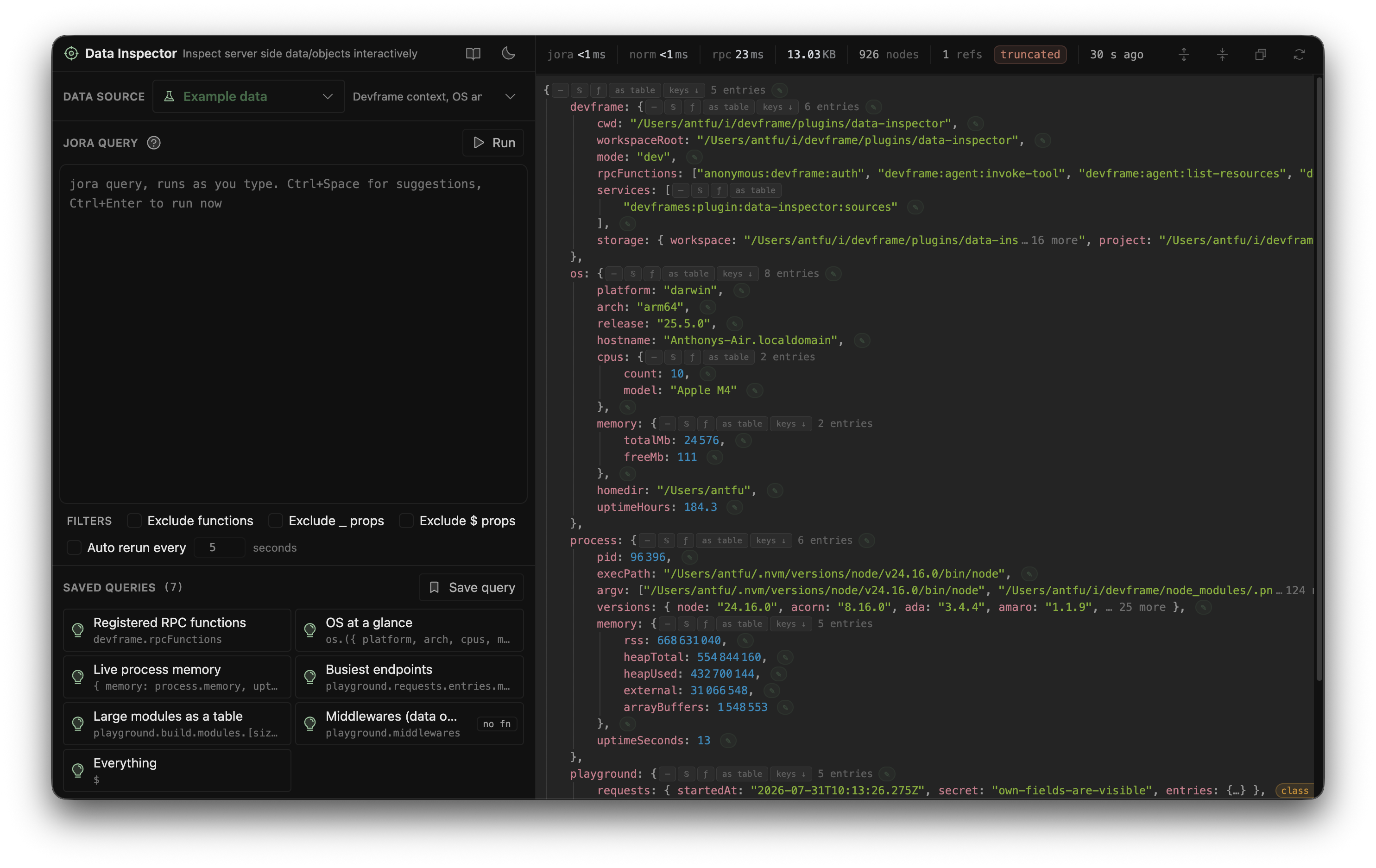
When mounted, other tools contribute data sources. A Vite plugin could expose its plugin container, a host framework could expose runtime state, and a test runner could expose its test graph. All of them can reuse the same query workbench and data viewer across host frameworks.
Terminals
@devframes/plugin-terminals is built with Svelte and provides a browser-based terminal panel supporting read-only process output and interactive PTY sessions.
This separates the process-running capability from the tool that renders it. A DevTools host can give multiple tools a consistent place for subprocess output and interactive commands while keeping the user's main terminal focused.
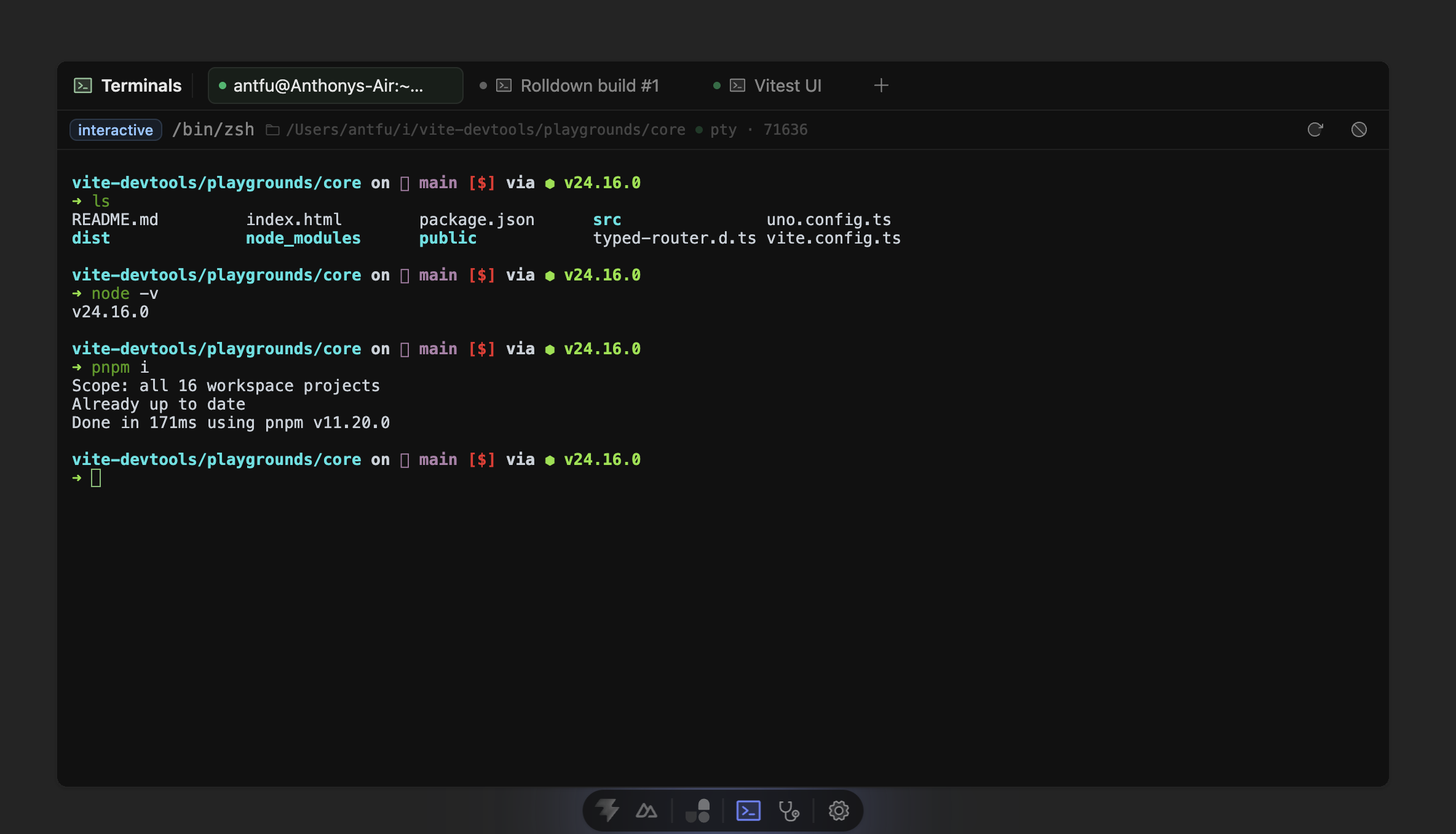
It also ships a standalone CLI:
pnpx @devframes/plugin-terminals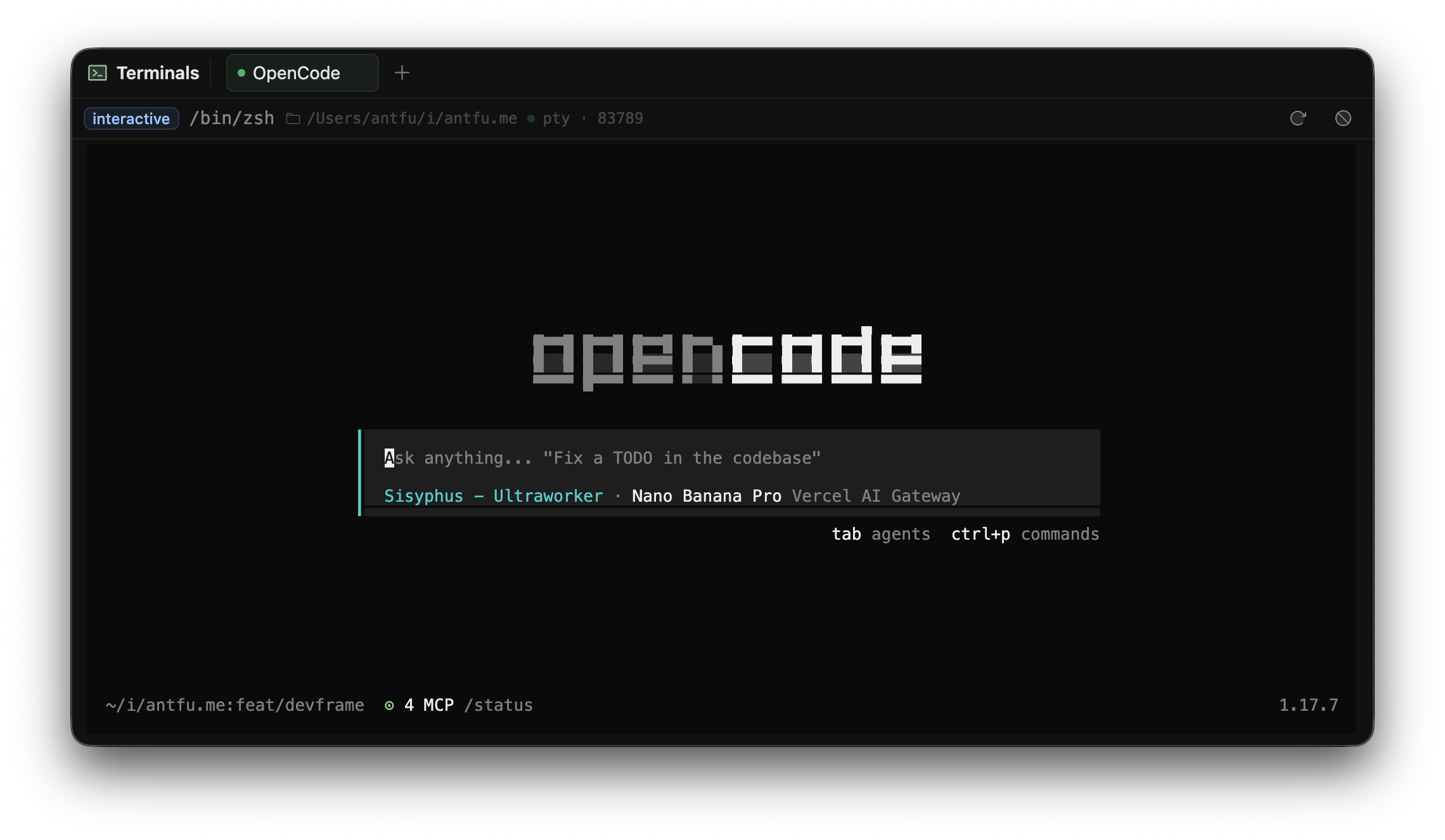
This opens the interactive terminal directly in your browser. You can use it to manage processes, run commands, or run coding agents like Claude Code from the browser.
Accessibility Inspector
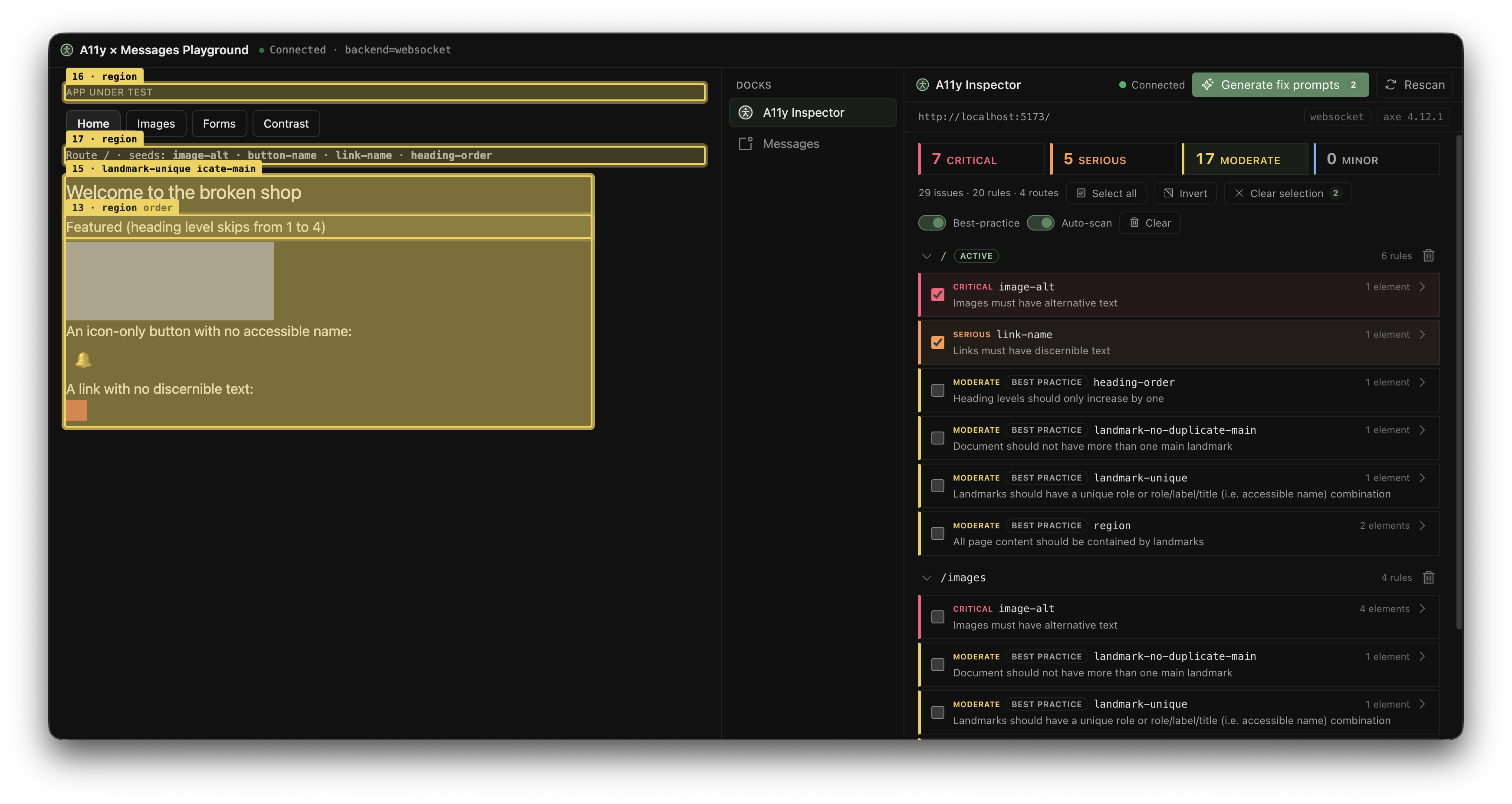
@devframes/plugin-a11y is built with Solid. Its page script scans the user app with axe-core, lists WCAG violations, and highlights the corresponding elements on the page. It can also turn the findings into fix prompts for coding agents, connecting visual inspection with a coding-agent workflow.
With a standalone adapter, its panel and page script can inspect any page. Inside a DevTools host, the same findings can also be mirrored into the shared message feed.
It is heavily inspired by @nuxt/a11y, which brought real-time accessibility feedback into Nuxt DevTools. Extracting the idea into a built-in devframe makes the same capability available beyond Nuxt.
More Built-in Devframes
Other built-in devframes cover a VS Code editor on the web, asset management, a Git panel, Open Graph previews, and Devframe's own RPC and state inspector. They share the devframe definition and protocol while each chooses its own UI framework.
These built-in devframes show what Devframe can support and offer starting points for communities to build their own. We believe many more interesting DevTools will emerge over time. You can follow the growing list on the Ecosystem page.
From One Devframe to a DevTools Host
So far, we have one portable devframe. Once several devframes are active together, another problem appears: discovery. How do users find and move between them?
Many DevTools log their own URL to the console:
~ pnpm dev

  VITE v8.2.1  ready in 32 ms

  ➜  Local:  http://localhost:3333/
UnoCSS Inspector: http://localhost:3333/__unocss/

> Visualized ESLint Config: http://127.0.0.1:3333/.eslint-config/
  ➜  Vite Inspect: http://localhost:3333/__inspect/
Sometimes DevTools also inject floating buttons into the user app:
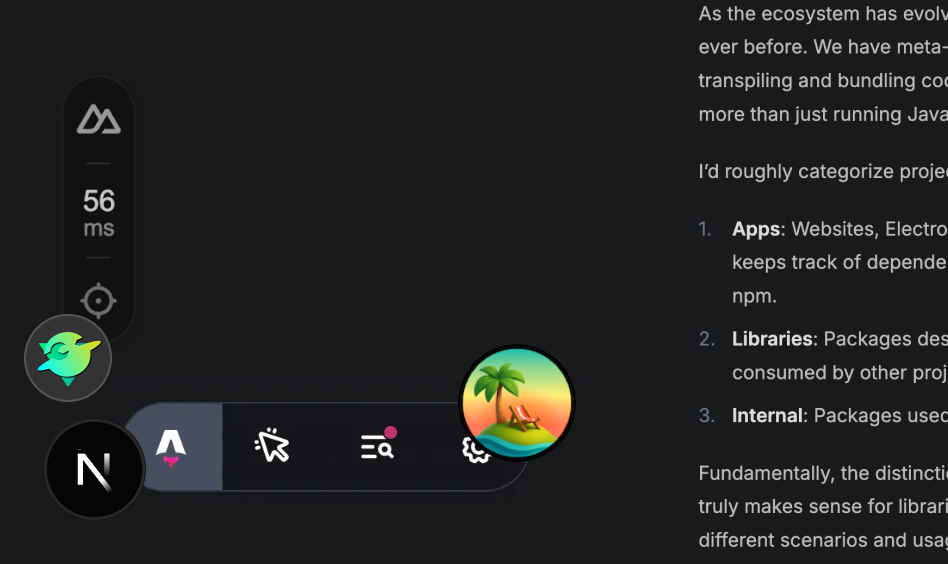
(this is a made-up example to demonstrate the problem)
As more tools join the project, the console becomes a directory of URLs and the page gains a collection of unrelated floating buttons. Each devtool also has to build and maintain its own discovery mechanism.
To improve this, Devframe also provides a composition layer: the hub.
@devframes/hub is headless and framework-neutral. Multiple devframes mount into it and contribute docks, commands, messages, terminals, and shared state. To users, they appear through one consistent entry point. To the tools, the hub provides a shared context in which they can discover and collaborate with one another.
The same mounting model scales from one devframe to the whole collection. initHub() puts the hub and all of its mounted devframes behind one Web Standard handler:
import { initHub } from '@devframes/hub/initiate'
import { createTerminalsDevframe } from '@devframes/plugin-terminals'
import { createXxxDevframe } from '...'

const hub = initHub({
  /**
   * The common base path for all mounted devframes.
   * `/__my-tool/` becomes `/__devframes/__my-tool/`.
   */
  base: '/__devframes/',
  /** The devframes are mounted into the hub. */
  devframes: [
    createTerminalsDevframe(),
    createXxxDevframe(),
    // ...
  ],
  /**
   * We ship a reference UI to make it easy to get started,
   * but you can provide your own layer to match
   * your product's design system and interaction model.
   */
  ui: await import('@devframes/hub-ui').then(m => m.createUi()),
})

// The same handler/middleware API as a standalone devframe.
hub.handler
hub.nodeMiddleware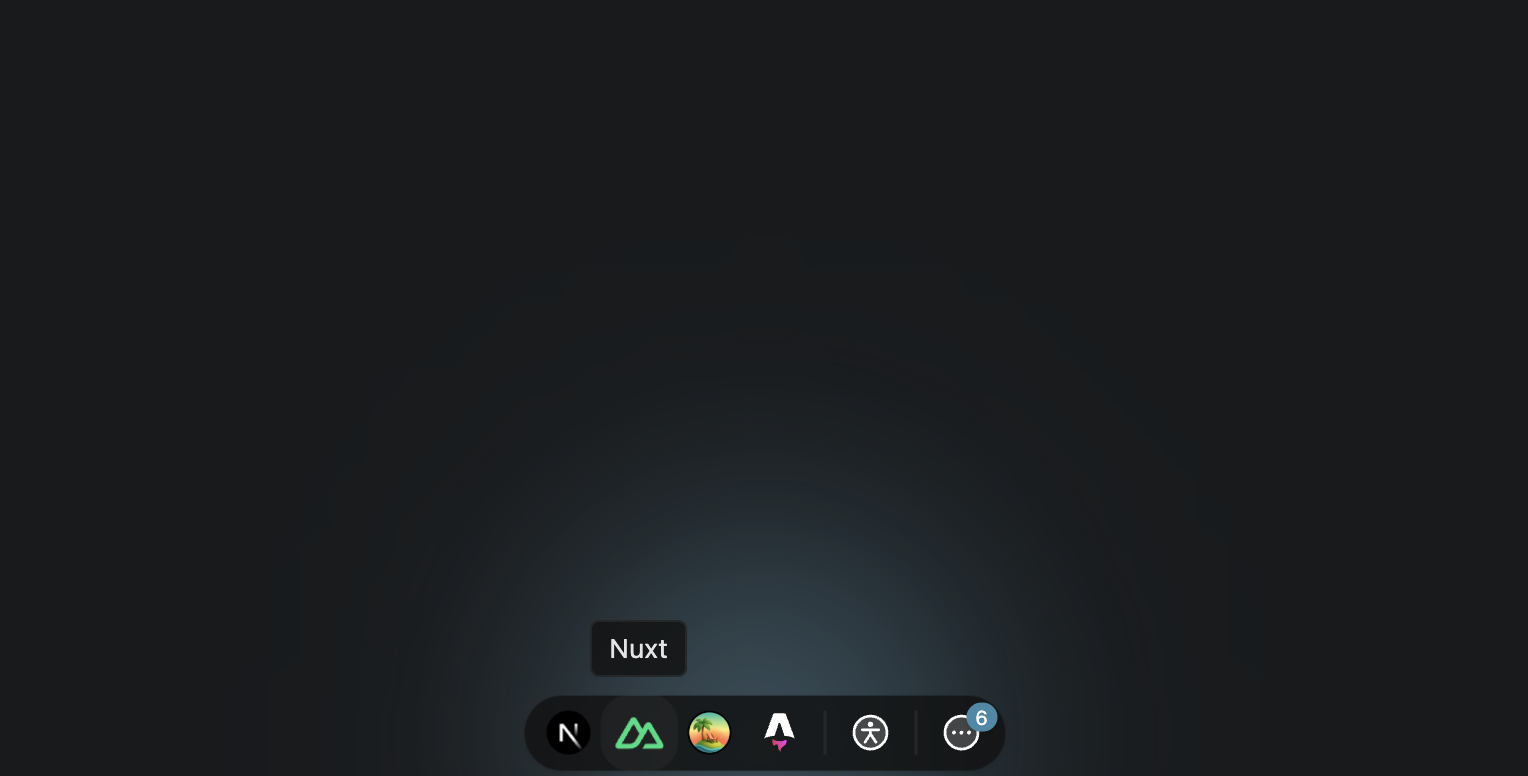
(this is a made-up example for demonstration)
Mounted devframes share one RPC registry, state store, connection, authentication gate, and optional aggregate MCP endpoint. The hub remains headless: @devframes/hub-ui provides the reference hub UI provider, while a product can supply another hub UI provider independently of the underlying tools.
Like a single devframe, a hub can mount into almost any host framework through the standard handler. The repository includes working reference projects for Vite, Next.js, Hono, Nitro, and Rsbuild. Each example connects the same handler and UI entry to its host framework's native server API. A complete DevTools host can build its own design system and interaction model on top of the hub's foundation.
Vite DevTools
Vite DevTools is the first flagship DevTools host built on this foundation. It brings a Vite-focused interface and Vite-native capabilities while using initHub() for composition and serving. Alongside Vite and Rolldown analysis, Vitest UI, and Oxc tooling, it gives independent devframes a common place to work together.
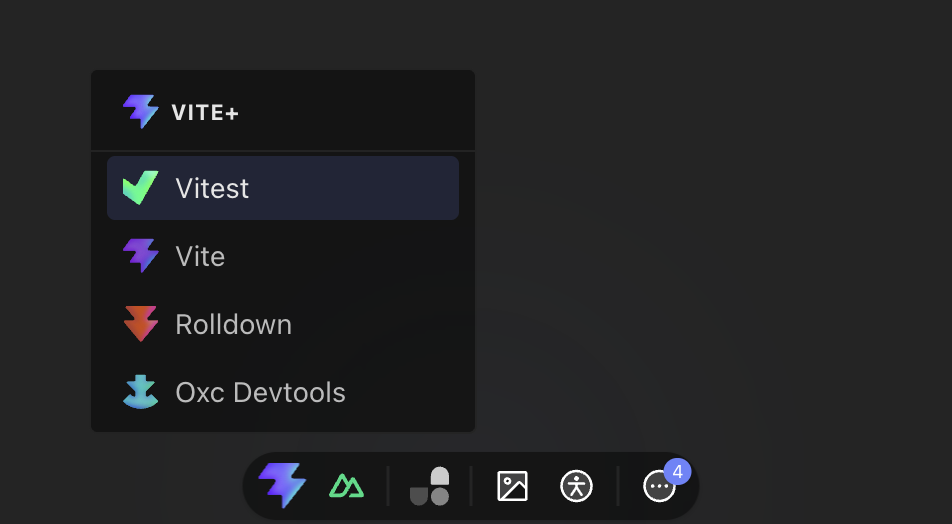
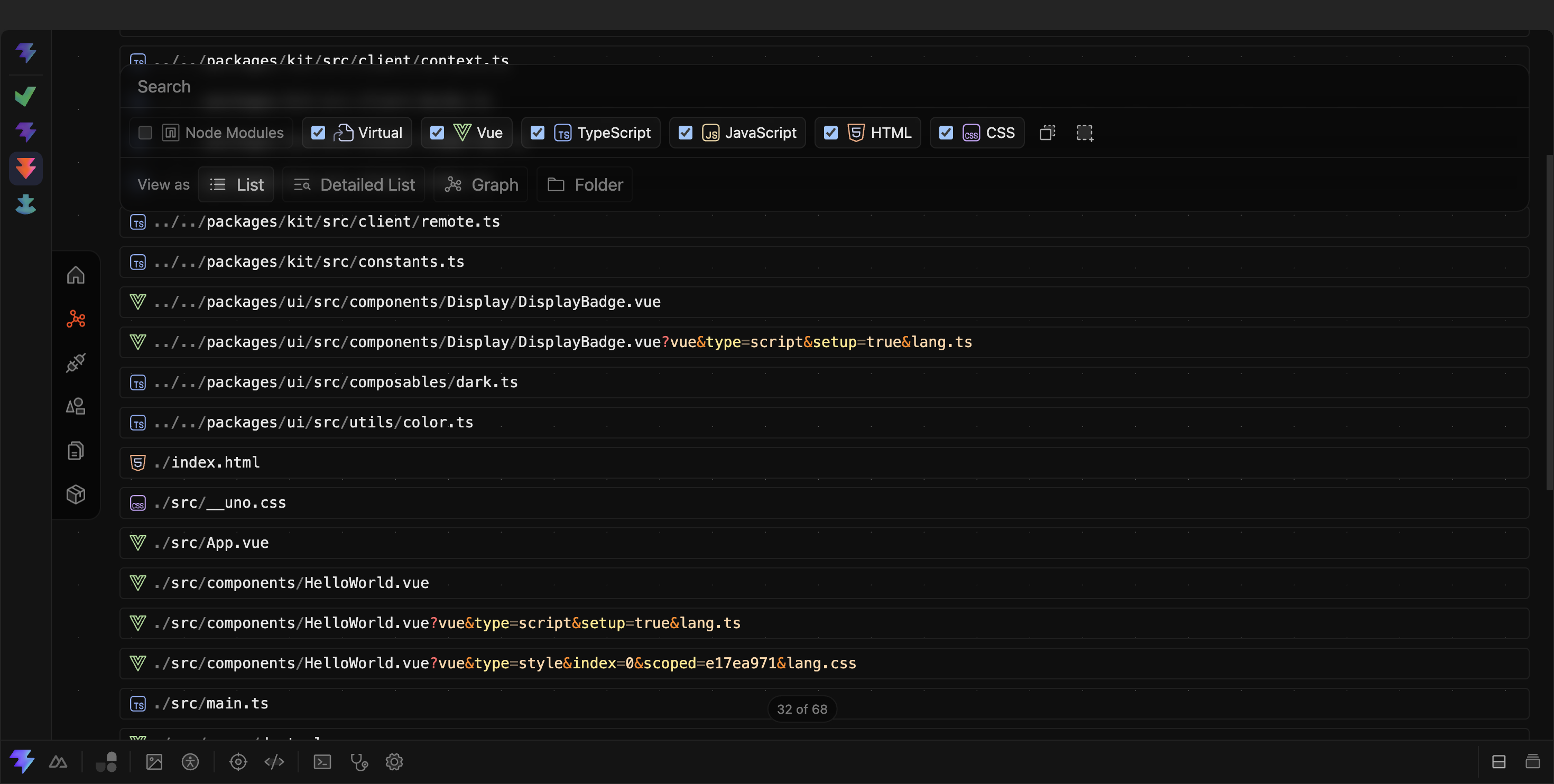
A devframe can join Vite DevTools through an adapter. A regular Vite plugin can also contribute directly through the new devtools.setup entry:
// vite.config.ts
import { createPluginFromDevframe } from '@vitejs/devtools-kit/node'
import { createMyDevframe } from 'my-devframe-tool'
import { defineConfig } from 'vite'

const myDevframe = createMyDevframe()

export default defineConfig({
  devtools: true,
  plugins: [
    // Helper to turn a devframe into a Vite plugin.
    createPluginFromDevframe(myDevframe),
    // A regular Vite plugin can also contribute directly.
    {
      name: 'vite-plugin-my-tool',
      devtools: {
        setup(ctx) {
          // Devframe context with Vite-specific augmentations.
        },
      },
    },
  ],
})
The adapter turns an existing devframe into a Vite plugin. The devtools.setup entry lets Vite plugins use the same context directly. This makes adoption incremental: tools can start where they are and still participate in the shared ecosystem.
Nuxt DevTools
The new Nuxt DevTools v4 builds on top of both Devframe and Vite DevTools. It now would inherits the ecosystem of both of them.
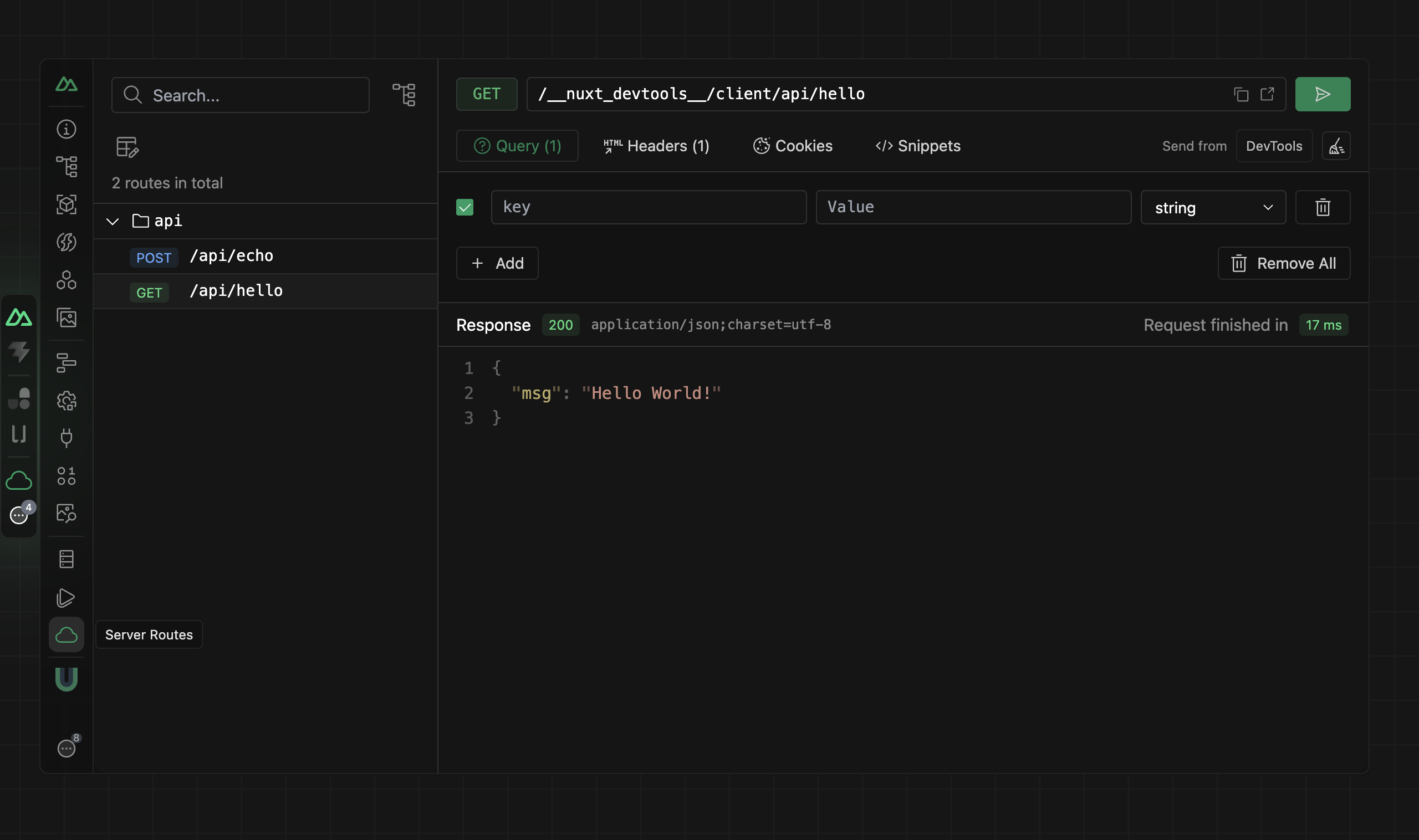
Here are the stacking layers to demonstrate this better:
Vue DevTools is also migrating to the Vite DevTools foundation. Vue capabilities such as component and reactivity inspection can then coexist with Vite-native capabilities and framework-neutral devframes in the same DevTools host.
In a way, the story has come full circle: the wish that started with Nuxt DevTools now returns with a concrete foundation underneath. Nuxt DevTools v4 is expected to ship with Nuxt v5 and will also be available as a manual opt-in for Nuxt 4.
Next.js DevTools (Prototype)
We are also experimenting with the integrations of bringing Devframes to Next.js DevTools, and internally, we have a working prototype to have Devframes Hub working inside Next.js DevTools without any modifications to the installed devframe plugins.
(this is an internal prototype, it's not yet available and does not represent the final state)
Inheriting the Ecosystem
Framework-specific layers keep their own look and can be much richer because they understand their framework's conventions and runtime. The infrastructure stays shared while the final experience remains specific.
Devframe itself remains independent of Vite and any framework. A future framework-specific DevTools host can mount the same hub and devframes, then add its own knowledge and presentation on top of the shared foundation:
 A devframeOne devtool definitionVite DevToolsFirst flagship DevTools host
Build Your Own DevTools
Devframe supports framework authors and established tooling teams as well as project-specific DevTools and one-off visualizations. With built-in coding-agent skills and a growing collection of real-world examples, we are exploring a future where you might ask a coding agent:
"Build me a one-off devframe to visualize my app's network request flow and highlight the bottlenecks."
A useful devtool might exist only long enough to answer one question. We will keep improving Devframe and its ecosystem so these pluggable, extensible, and playful tools become practical for more people to build.
What's Next
Devframe v1.0 stabilizes the interface for the community to build on and experiment with. Vite DevTools will follow with a stable release, while Nuxt DevTools v4 and the Vue DevTools migration continue testing the model at the framework level.
This is the first credible implementation toward the modular DevTools infrastructure we imagined years ago. There are more host frameworks to connect, mounting conventions to refine, and coding-agent practices to discover.
What excites us is the possibility that a good tool can be built once, travel further, and become better as more communities contribute to it: shared infrastructure underneath, specific and playful experiences on top, and structured capabilities available to both people and coding agents.
We are still exploring the best practices, especially around coding-agent interfaces, permissions, and cross-tool collaboration. Any kind of contribution is welcome: devframes, experiments, design ideas, use cases, feedback, or simply trying the tools and sharing what you find.
If this direction sounds interesting to you, check out the Devframe repository, try building something with it, and leave us some feedback. We are looking forward to seeing what we can build together!
Thanks
This vision has come a long way with the help of many people.
A huge thank you to  webfansplz, who has put a tremendous amount of work into Vite DevTools. We also owe a lot to
  Akryum: his work on Vue DevTools and testing framework UIs has inspired us for years, and he spent a great deal of time brainstorming and prototyping these DevTools ideas with us.
  hyfdev helped coordinate with Rolldown and shape the APIs that made Vite DevTools possible.
  Atinux planted the seed of Nuxt DevTools, invested so much in building it, and now continues that investment in Vite DevTools.
  danielroe provided valuable feedback on Nuxt DevTools and kept motivating us to push further on bundle size (the installed size of Vite DevTools core dropped by 30 MB from v0.1 to v0.5).
  posva for providing great feedback on Devframe's documentation and helping on the integrations.
Thanks also to  yuyinws for donating Oxc Inspector to Vite Plus DevTools and continuing to maintain it; and to
  SaKaNa-Y and
  dvcolomban for being early adopters and contributing extensively to both Vite DevTools and Devframe.
And, of course, thanks to everyone who has contributed to Vite DevTools, Nuxt DevTools, and Vue DevTools along the way. This work is built on top of all those contributions.
And thanks to Vercel for supporting these projects and bringing our ambitious plan for unified DevTools within reach.